

 Share
Share Print
Print Facebook
 Email
EmailNews And Events
St. Eustatius and the First Salute
News
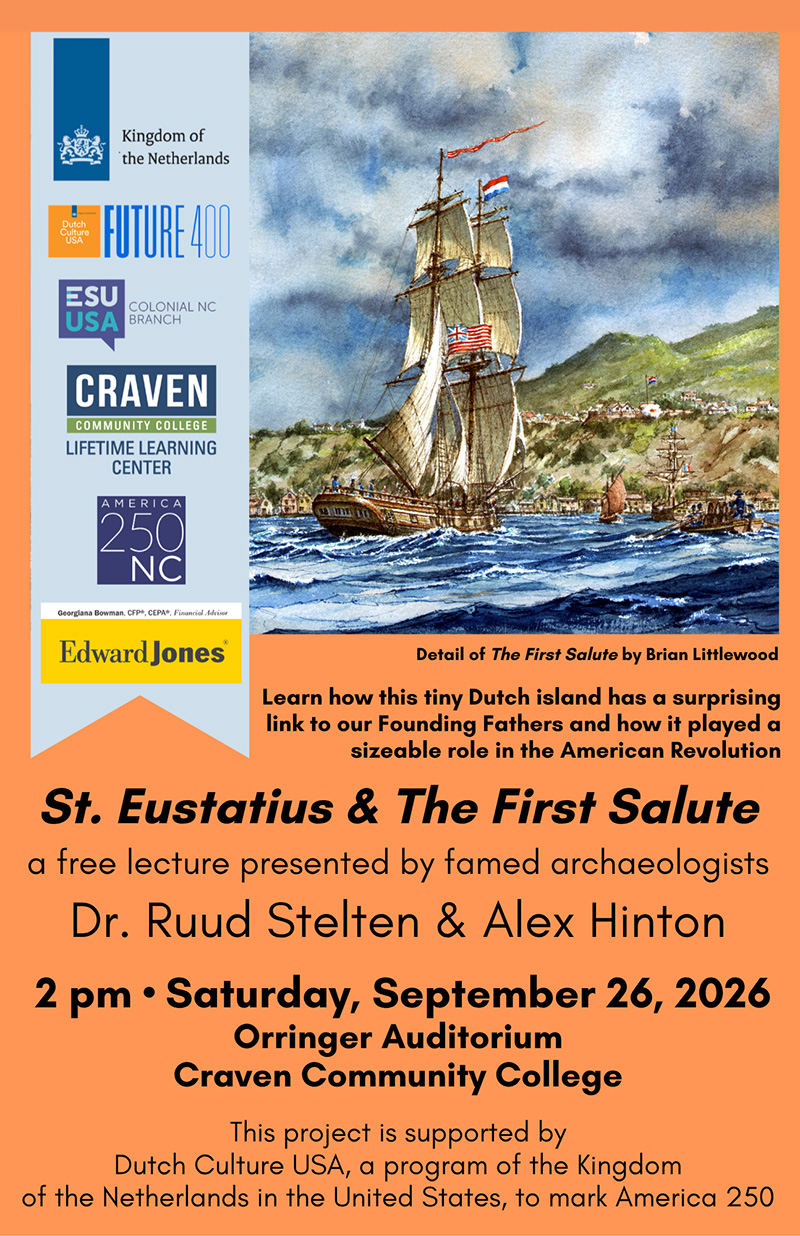
Through archaeological discoveries and newly uncovered archival evidence, Stelten and Hinton will explore the crucial role of the Caribbean island of St. Eustatius during the American Revolution. Often called the "Golden Rock," this tiny Dutch island served as a major hub for international trade, supplying desperately needed gunpowder, arms, and other goods to the American colonies. The presentation will examine how St. Eustatius connected North Carolina ports such as New Bern, Beaufort, Wilmington, and Edenton to Atlantic trade networks, and how maritime archaeology is helping researchers reconstruct these forgotten connections.
The lecture will also revisit the famous "First Salute" of November 16, 1776, when the Dutch governor of St. Eustatius returned a cannon salute to the American brig Andrew Doria, an act widely regarded as the first formal foreign recognition of the United States. In addition, the lecture will feature newly uncovered evidence relating to Alexander Hamilton's early childhood on St. Eustatius, offering fresh insights into the future Founding Father's formative years in the Caribbean.
The project is supported by a grant from Dutch Culture USA, a program of the United Kingdom of the Netherlands in the United States to mark America 250. This grant was one of only eight awarded nationwide after a competitive grant process. ESU thanks additional sponsors, including media partner Public Radio East and Georgiana Bowman, CFP®, CEPA®, a financial advisor with Edward Jones.
For more information, please contact Jennifer Baer, Director of Craven Community College Lifetime Learning Center and Community Engagement, at baerj@cravencc.edu.
